It would be a mistake to attempt to define geographic limits for New York’s five families. Family influence is not confined to a region of the city or even to the entire city itself. The influence of New York families can be felt throughout the Northeast and all across the country. There is certainly no correlation between the five criminal organizations and New York City’s five boroughs. Dividing lines exist in formal family membership (though personal allegiance often crosses family boundaries) and in family rackets. Aside from the small regions designated as mob headquarters, there are no meaningful geographic “territories.”
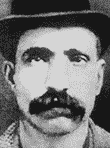
1895 – Giuseppe Morello (Born Corleone, Sicily, May 2, 1867. Killed New York City, Aug. 15, 1930). Known as “Piddu” or “Clutch Hand” (in erroneous reports as “Peter”), Morello and his brother-in-law Ignazio Lupo led a gang of extortionists and counterfeiters in Italian East Harlem, Manhattan’s Lower East Side and Brooklyn. With the support of Sicilian/American Mafiosi like Vito Cascioferro, Pasquale Enea and Ignazio Lupo, and with strong connections to Mafia organizations in New Orleans and Chicago, Morello was able to assemble a sprawling crime fraternity in the New York region and win recognition as boss of bosses of the whole U.S. Mafia, perhaps the first man to hold that title. It is unclear whether Morello’s New York organization was a single entity or a conglomeration of various smaller Mafias that allied or merged under his leadership. In 1910 Morello was jailed, along with Lupo and others in their criminal society, on a counterfeiting conviction. The Morello organization subsequently broke down (or devolved) into competing factions that may be viewed as the roots of the Genovese, Gambino and Lucchese Crime Families.
1911 – Salvatore D’Aquila (Born Palermo c. 1873. Killed New York City, Oct. 10, 1928). Known to his underworld associates as “Toto,” Palermo-born D’Aquila arrived in New York by 1904. He reportedly rose up through the ranks of the Morello Mafia, though it is likely he commanded a Palermo-oriented faction in a Morello-led conglomeration of Mafias. D’Aquila had a divided powerbase, with resources in both the Bronx and southern Brooklyn. He originally based his operations in the Bronx. At the height of his power, he relocated to Brooklyn, perhaps taking over remnants of an Ignazio Lupo organization there. Following the counterfeiting convictions of Morello, Lupo and others in 1910, the Morello New York organization fractured. D’Aquila became the most influential boss of the competing Mafia factions in New York City and secured support from allies around the country for designation as the new boss of bosses. However, he was unable to incorporate East Harlem and lower Manhattan into his underworld empire and resorted to assassination and gangland warfare in an effort to do so. In East Harlem, Morello’s half-brothers, Nicholas, Vincent and Ciro Terranova, and their relatives the LoMontes were in control of a group that eventually became dominated by an anti-D’Aquila boss in lower Manhattan named Giuseppe Masseria. D’Aquila never felt secure (and perhaps never was secure) in his leadership position. He is known to have inserted spies into the administrations of various crime families across the country. Upon Morello’s release from prison, D’Aquila created a schism in the New York Mafia by passing a death sentence against Morello loyalists. Years of conflict resulted. Masseria emerged as D’Aquila’s strongest adversary. Around 1925, with the war against Masseria virtually lost, D’Aquila abandoned Brooklyn to return to his Bronx roots. (Though this “Gambino” Crime Family is often depicted as a Brooklyn organization, D’Aquila and the next two family bosses held great strength in the Bronx.)
1928 – Manfredi Mineo (Born Palermo, Sicily, c. 1879. Killed Bronx, Nov. 5, 1930). Also known as “Alfred” or “Al,” Mineo was a key early ally of Salvatore D’Aquila and likely led his own Mafia organization within a D’Aquila Mafia conglomeration. The two had a falling out, perhaps over the D’Aquila death sentences against Morello loyalists. Mineo subsequently allied with Giuseppe Masseria during his 1920s underworld war against D’Aquila. After D’Aquila’s murder at the corner of Manhattan’s Avenue A and 13th Street on Oct. 10, 1928, Masseria supported Mineo’s claim as new boss of D’Aquila’s large underworld organization. While Mineo succeeded D’Aquila as boss, it is likely that he was resented by a continuing D’Aquila faction. Mineo’s chief lieutenant is believed to have been Bronx-based Steve Ferrigno. Mineo and Ferrigno sided with Masseria during the Castellammarese War.
1930 – Frank Scalise (Born Palermo, c. 1893. Killed Bronx, June 17, 1957). Al Mineo and Steve Ferrigno were ambushed and killed Nov. 5, 1930, in the courtyard of a Bronx apartment building (Alhambra Apartments, 750-60 Pelham Parkway). Mineo’s opponents took advantage of his death and prevented the criminal organization from reuniting within the Masseria camp. Bronx-based Frank Scalise seized control of the family and joined Masseria opponents in the Castellammarese War.
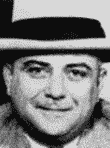
1931 – Vincent Mangano (Born Palermo, Dec. 1888. Disappeared 1951). After the conclusion of the Castellammarese War to unseat Masseria, victorious boss of bosses Salvatore Maranzano was himself betrayed and murdered under orders of Charlie Luciano. The strength of Scalise, a Maranzano supporter, was undermined, and the crime family recognized Vincent Mangano as boss. Vincent and his brother Philip had been powerful Brooklyn waterfront racketeers for some time. They had connections to the Mafia of western New York State and were on good terms with Charlie Luciano. Former boss Frank Scalise remained an important part of the crime family. In 1951, the Manganos became a focus of the Kefauver Committee investigations in New York City. But the committee could not locate them. Some sources indicate Philip Mangano spoke to federal investigators behind closed doors.
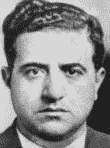
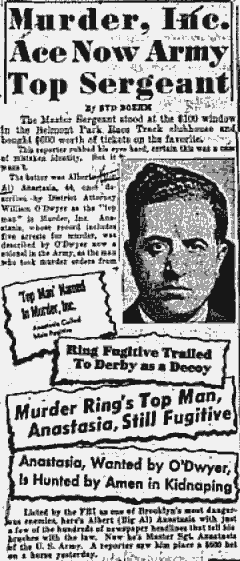
1951 – Albert Anastasia (Born Tropea, Calabria, Italy, Feb. 26, 1902. Killed New York City, Oct. 25, 1957). Philip Mangano was found murdered in 1951, just as his brother Vincent disappeared. Philip’s body was discovered April 19 near Jamaica Bay south of Avenue Y in Bergen Beach, Brooklyn. He had been shot three times in the head. Vincent Mangano was never found. Crime family underboss Anastasia, a veteran of Brooklyn underworld violence since the dawn of Prohibition, rose to lead the Mangano family. He appointed Carlo Gambino, a leader of the strong Palermo Sicily-oriented faction in the crime family, to be his underboss. Anastasia was engaged in labor racketeering at the waterfront and reportedly served as the Mafia’s overseer of the activities of Brooklyn-based Murder, Inc. During Anastasia’s reign, he resided in Fort Lee, New Jersey, near the home of Joe Adonis. (Anastasia’s Bluff Road residence, near Arcadian Way, was about a quarter mile from Adonis’s home on Dearborn Road.)
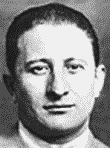
1957 – Carlo Gambino (Born Palermo, Aug. 24, 1902. Died Massapequa, NY, Oct. 15, 1976). Anastasia was shot to death by unknown assassins in the barber shop of the Manhattan Park Sheraton Hotel on Oct. 25, 1957. He had been making an effort to involve himself in Cuban gambling operations just before his murder. It is believed that underboss Carlo Gambino conspired with powerful Neapolitan underworld leader Vito Genovese and established Cuban gambling racketeers to eliminate Anastasia (a strong supporter of Genovese rival Frank Costello). Despite opposition from Anastasia loyalists within the crime family, Gambino stepped up to the boss role just before the ill-fated Apalachin underworld convention. Gambino faced strong competition inside and outside his crime family. As Gambino put down a rebellion by Armand Rava and former Anastasia supporters, he was supported outside his family by Genovese. Gambino eventually reconciled with the Anastasia wing of the family by elevating Rava’s old friend Aniello Dellacroce to the position of underboss, apparently securing a future return to power for the Anastasia faction. During his reign, Gambino repeatedly interfered in the business of other crime families. By 1975, Gambino was in ill health and allowed his relative Paul Castellano to run day-to-day operations.
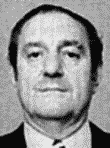
1976 – Paul Castellano (Born Brooklyn, June 26, 1915. Killed Manhattan, Dec. 16, 1985). Gambino died of a heart attack on Oct. 15, 1976, and his brother-in-law “Big Paul” Castellano, owner of a Brooklyn meat distributing business, became the next family boss. The old Anastasia wing of the crime family was offended by Castellano’s elevation, favoring Aniello Dellacroce for the top spot. Castellano allowed Dellacroce to remain part of the family leadership, even as he groomed Thomas Bilotti as his successor. During the late 1970s, Castellano was the most powerful of New York’s Mafia bosses. In his later years, he was a constant target for law enforcement. Federal agents managed to install electronic surveillance in Castellano’s home, obtaining compromising and embarrassing information on the crime boss. 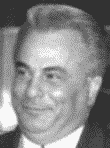
1986 – John Gotti (Born Bronx, NY, Oct. 27, 1940. Died Springfield, MO, June 10, 2002). Despite decades of friction and disappointment, Aniello Dellacroce kept his faction (the old Anastasia wing) loyal to Castellano. But, immediately following Dellacroce’s Dec. 2, 1985, death, John J. Gotti and other Dellacroce backers begin plotting against Castellano. Castellano and Thomas Bilotti were murdered Dec. 16, 1985, outside of Sparks Steak House in Manhattan. Gotti was brought to trial several times on racketeering charges. He early successes won him the nickname, “the Teflon Don.” He and his relatives controlled the crime family until his 2002 death from cancer in a federal prison hospital.
1910 – Fortunato LoMonte (Born Corleone, Sicily, July 15, 1869. Killed New York City, May 23, 1914). Also known as “Charles,” LoMonte became boss in East Harlem after Morello was imprisoned. Salvatore D’Aquila viewed LoMonte as a rival. LoMonte attempted to monopolize the Sicilian rackets in Lower Manhattan but was assassinated on orders from D’Aquila in 1914. His brother Thomas was murdered a year later.
1915 – Vincent Terranova (Born Corleone, Sicily, May 15, 1886. Killed New York City, May 8, 1922). Leadership of the East Harlem portion of the old Morello mob passed to Morello’s half-brothers Vincent and Nicholas “Coco” (Born Corleone, Sicily, Jan. 6, 1890. Died Brooklyn, Sept. 7, 1916) Terranova. Vincent Terranova became the key figure in the East Harlem Mafia after brother Nicholas was murdered in 1916 on his way to a peace conference with a Brooklyn Camorra group.
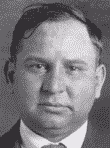
1922 – Giuseppe Masseria (Born Menfi, Sicily, Jan. 17, 1886. Killed Brooklyn, April 15, 1931). Vincent Terranova was killed at 116th Street and 2nd Avenue on May 8, 1922, during a conflict between Morello loyalists and the organization of Brooklyn-based boss of bosses Salvatore D’Aquila. “Joe the Boss” Masseria, one-time member of a lower Manhattan burglary ring, became standard-bearer for the remnants of the Morello-Terranova organization. Masseria united underworld forces – including non-Sicilians – in New York, Chicago, Detroit and Cleveland to defeat D’Aquila and his many allies. Masseria became boss of bosses after D’Aquila’s murder in 1928. Among his chief advisers were former boss of bosses Giuseppe Morello and former D’Aquila friend Saverio Pollaccia.
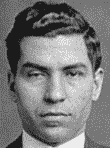
1931 – Charlie Luciano (Born Lercara Friddi, Sicily, Nov. 24, 1897. Died Naples, Italy, Jan. 26, 1962). With assistance from Giuseppe Masseria’s other lieutenants, Luciano (real name Salvatore Lucania, a.k.a. “Charlie Lucky”) betrayed Masseria and had him murdered at Gerardo Scarpato’s Nuova Villa Tamaro restaurant at Coney Island on April 15, 1931. Luciano took over the Masseria organization. Vito Genovese, a Neapolitan crime leader with strong support in lower Manhattan, Brooklyn and New Jersey, became Luciano’s second-in-command. After subsequently betraying boss of bosses Salvatore Maranzano, Luciano became the most powerful man in the American Mafia. Maranzano was the last boss of bosses of the American Mafia. Luciano and his allies insisted on the creation of a Commission system for resolving interfamily disputes. The first Commission members were the five bosses of New York City, the boss of Chicago and the boss of Cleveland.
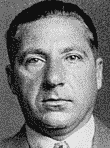
1937 – Frank Costello (Born Cosenza, Italy, 1891. Died New York City, Feb. 18, 1973). Luciano was convicted of running a prostitution ring in June 1936. Just six months later, his underboss Vito Genovese fled the country to Fascist Italy in order to avoid prosecution for the Ferdinand Boccia murder of Sept. 19, 1934. It is uncertain whether Genovese served as boss before he left (Luciano probably would not have stepped down while his appeals were being processed). Costello, architect of Mafia gambling rackets, assumed control of the day-to-day operations of the crime family by 1937, though imprisoned Luciano may still have held the boss designation. Costello’s leadership on the Mafia Commission and his strong connections to political figures caused him to be known as the “Prime Minister” of the underworld. In 1946, Charlie Luciano was released from prison and deported to Italy. In his absence, Frank Costello was universally recognized as the family’s full boss.
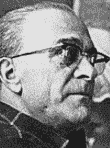
1957 – Vito Genovese (Born Risigliano near Naples, Nov. 21, 1897. Died Missouri, Feb. 14, 1969). Genovese was apprehended by the U.S. Military in Italy and returned to the U.S. to be tried for murder. The death of key witness helped him avoid conviction. A May 2, 1957, assassination attempt on Costello left Costello wounded and caused him to retire. Genovese became boss but would actively perform that role only briefly. He was jailed on drug charges in 1962 and used a number of acting bosses to run the crime family after that. Genovese underboss Gerardo Catena (1902-1905 to 2000) appeared to lead the leadership group from 1962 until Genovese’s death in 1969. The group included Tommy Eboli and Genovese’s consiglieri Mike Miranda.
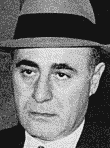
1969 – Thomas Eboli (Born Italy, June 13, 1911. Killed Brooklyn, July 16, 1972). Also known as “Tommy Ryan,” New Jersey resident and Greenwich Village capodecina Eboli took over the Genovese family upon Genovese’s death in prison. Eboli was close to rising Genovese Mafioso Vincent Gigante. When Gigante was a boxer, Eboli served as his manager. As crime family boss, Eboli had an antagonistic relationship with Carlo Gambino.
1972 – Phil Lombardo (Born c.1908. Died 1987). Boss Tommy Eboli was shot to death near his girlfriend’s Crown Heights, Brooklyn, home on July 16, 1972. The murder was likely the result of a power struggle influenced by outsiders. Carlo Gambino reportedly hoped to see Frank “Funzi” Tieri (Born Feb. 22, 1904. Died Brooklyn, March 31, 1981) succeed Eboli as the next Genovese boss. Instead the crime family quitely sided with Phil “Benny Squint” Lombardo. Lombardo screened his underworld activities behind front men, including Frank Tieri and Anthony “Fat Tony” Salerno (Born, Aug. 15, 1911. Died Rhinebeck, NY, July 27, 1992).
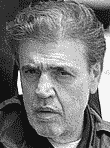
1981 – Vincent Gigante (Born New York City, March 29, 1928. Died Springfield, MO, Dec. 19, 2005). Lombardo retired to Florida, quietly passing control of the family to his consigliere Gigante, known as “the Chin.” Gigante, son of Neapolitan immigrants, is believed to have served as the Genovese gunman responsible for the botched hit on Costello in 1957. Like Lombardo, Gigante used Anthony “Fat Tony” Salerno (Aug. 15, 1911 to July 27, 1992) as a front man. Gigante also screened his underworld activities by posing in public as mentally ill.
1915 – Stefano Magaddino (Born Castellammare del Golfo, Sicily, Oct. 10, 1891. Died July 19, 1974). Magaddino was a representative of the powerful Bonventre-Bonanno-Magaddino Mafia clan of Castellammare del Golfo. He arrived in the U.S. early in 1909 and shortly after associated himself with the Mafia in Chicago. He became leader of a tightly knit Castellammarese crime family based in Williamsburg, Brooklyn, before the start of Prohibition. The organization had branches in Buffalo and Endicott, New York, as well as Detroit, Michigan, and Philadelphia, Pennsylvania. Gaspare Milazzo (“Scibilia”), later known as a Detroit crime family leader, also looks to have been part of the early Brooklyn family leadership. Magaddino later left New York City but remained influential in the Williamsburg organization for at least a decade after his self-imposed exiles to Philadelphia and then to Buffalo. He claimed to be influencing the Brooklyn organization well into the reign of his cousin Joseph Bonanno.
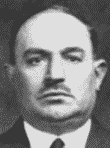
1921 – Cola Schiro (Born c.1880. Disappeared 1930). Schiro led a non-Castellammarese Mafia organization that merged with the Brooklyn Castellammarese family as Stefano Magaddino moved to Buffalo. As the Castellammarese were the strength of crime family, Schiro became a Magaddino puppet ruler. As friction between the Castellammarese and boss of bosses Giuseppe Masseria grew around 1930, Schiro was criticized within the family for his pacifism.
1930 – Joe Parrino (Born c.1890. Killed Brooklyn, Jan. 19, 1931). As the Castellammarese Sicilians in Schiro’s organization, including Salvatore Maranzano and Joe Bonanno, began to oppose Joe Masseria, boss Cola Schiro vanished. It appears that he crossed the Atlantic and returned to Sicily. Some believe Masseria exacted a tribute payment from Schiro to undermine his support in the crime family, and then had him murdered. Masseria took the opportunity to insert his own ally, Joe Parrino, into the leadership of the rebellious underworld group. Parrino was the brother of a recently murdered Detroit mobster, Sam (also known as Rosario and Sasa) Parrino.
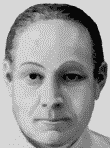
1930 – Salvatore Maranzano (Born Castellammare del Golfo, Sicily, c. 1886. Killed New York City, Sept. 10, 1931). Parrino was unable to hold together the Castellammarese clan. Many secretly defected to a guerrilla organization created by Maranzano. Though there is no evidence that Maranzano was ever officially appointed to any rank higher than soldier within the Schiro clan, he became the New York City war leader of the Castellammarese network in the U.S. and many other Mafiosi who opposed the tyrannical reign of Giuseppe Masseria, including D’Aquila loyalists from the Mineo Crime Family (Gambino). Upon the murder of Parrino, the rest of the Schiro clan joined Maranzano’s war effort. After the April 1931 assassination of Masseria, Salvatore Maranzano secured for himself the designation of boss of all bosses in the American Mafia. He made repeated demands of tribute from other Mafia families and plotted against those he considered his rivals.
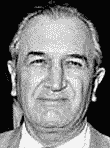
1931 – Joseph Bonanno (Born Castellammare del Golfo, Sicily, Jan. 18, 1905. Died Tucson, AZ, May 11, 2002). Charlie Luciano and his allies set up the assassination of Maranzano at his Park Avenue offices on Sept. 10, 1931. This may have been done with the approval of leading Castellammarese Mafiosi like Stefano Magaddino and Joseph Bonanno. Either during Maranzano’s reign as boss of bosses or immediately following Maranzano’s death, Bonanno became boss of the largely Castellammarese crime family based in Williamsburg, Brooklyn.
1964 – Gaspar DiGregorio (Born 1905. Died Smithtown, NY, June 11, 1970). On a morning he was called to testify in a racketeering probe, Joe Bonanno disappeared. His heir apparent, his son, was ignored by the commission, which appointed Gaspar DiGregorio to head the family. Bonanno’s son retained the allegiance of much of the family, and the Banana War resulted.
1966 – Joseph Bonanno (Born Castellammare del Golfo, Jan. 18, 1905. Died Tucson, AZ, May 11, 2002). Bonanno resurfaced in May 1966, claiming he had been kidnapped. The commission dropped its support of DiGregorio and allowed Bonanno to restore order to his family. Carmine Galante became Bonanno underboss.
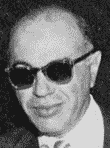
1968 – Natale Evola (Born Feb. 22, 1907. Died Brooklyn, Aug. 28, 1973). Bonanno decided to retire, reportedly after a heart attack. Some sources suggest that Bonanno was forced to leave New York after the exposure of his plot to assassinate Carlo Gambino and Gaetano Lucchese. The family came briefly under the leadership of Natale Evola. It appears that Evola did not have time (or possibly the ability) to bring the entire organization under his control. Instability continued within the Bonanno clan for much of the next two decades.
1973 – Philip Rastelli (Born Jan. 31, 1918. Died Brooklyn, June 24, 1991). Upon Evola’s death of cancer in 1973, Philip “Rusty” Rastelli took control of the Bonanno crime family. His first reign as boss lasted only a year.
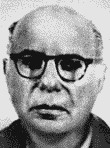
1974 – Carmine Galante (Born Feb. 21, 1910. Killed Brooklyn, July 12, 1979). Galante’s release from prison allowed him to take control of the family from Rastelli. (Some sources indicate that Galante never reached the rank of boss and led only a rebellious wing of Rastelli’s family.) As one of the more ambitious and brutal Mafia heads in the United States, Galante immediately became a powerful underworld force and jeopardized the authority of the commission.
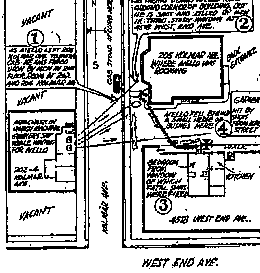
1979 – Philip Rastelli (Born Jan. 31, 1918. Died Brooklyn, June 24, 1991). Carmine Galante was murdered after a meal at Joe and Mary’s Restaurant, 205 Knickerbocker Avenue in Brooklyn, on July 12, 1979. Rastelli returned as boss of the Bonanno clan. His role in family matters diminished until his death in 1991.
1920 – Gaetano Reina (Born Corleone, Sicily, 1889-90. Killed Bronx, Feb. 26, 1930). A crime family headquartered in the Bronx appears to have been founded by Gaetano Reina before 1920. Reina may have served earlier as a group leader within the Morello organization and the later D’Aquila crime family of Brooklyn and the Bronx. D’Aquila’s mid-1920s decline and 1928 murder may have resulted in the establishment of an independent Reina crime family.
1930 – Joseph Pinzolo (Born c.1887. Killed Sept. 9, 1930). Reina was killed on Feb. 26, 1930, outside his girlfriend’s apartment building at 1521 Sheridan Avenue in the Bronx. His lieutenants believed boss of bosses Joe Masseria was responsible. Masseria supported his friend Joe Pinzolo as the new head of the Reina clan. However, Reina family group leaders Gaetano Gagliano and Gaetano Lucchese opposed Pinzolo and began to cooperate with Masseria’s enemies in the Castellammarese War.
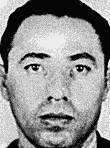
1930 – Gaetano Gagliano (Born c.1884. Died 1951). Gagliano and Gaetano Lucchese cooperated on the elimination of Masseria puppet Pinzolo from their organization. Pinzolo was shot to death at a “wine brick” office he shared with Lucchese at 1457 Broadway. Police found his body in Suite 1007, headquarters of California Dry Fruit Importers, with bullets in its left chest and neck. Gagliano took control of the family and used its resources to oppose Masseria.
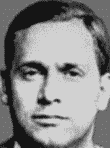
1951 – Tommy Lucchese (Born Palermo, Sicily, Dec. 1, 1899. Died Lido Beach, NY, July 13, 1967). Gaetano Gagliano died of natural causes around 1951. The precise date of his death is not known. (In 1952 testimony, Lucchese established that Gagliano was already dead.) Lucchese, also known as “Tommy Brown” and “Three-Finger Brown,” took over leadership of the family.
1966 – The Mafia commission began dividing up TommyLucchese’s personal rackets after he had been hospitalized for a year following surgery for a brain tumor and treatment for a heart condition.
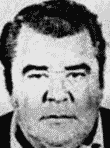
1967 – Carmine Tramunti (Born Oct. 1, 1910. Died Flushing, NY, Oct. 15, 1978). Tommy Lucchese died at his Lido beach, Long Island, home on July 13, 1967, after a series of illnesses and operations. Carmine Tramunti (left) briefly took over the Lucchese crime family.
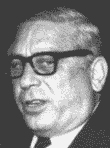
1970 – Antonio Corallo (Born East Harlem, NY, Feb. 12, 1913. Died Springfield, MO, Aug. 23, 2000). Aging Carmine Tramunti apparently continued to serve for a few years as a front for new boss Corallo (right). The actual date of “Tony Ducks” Corallo’s takeover is in doubt. Corallo continued to lead the family at least until his 1986 imprisonment.
1986 – Anthony Luongo (Born ?. Killed 1986). With Corallo sentenced to prison, Luongo attempted to seize leadership of the Lucchese family. He was murdered shortly thereafter.
1905 – Giuseppe Fontana (Born Villabate, Sicily, c.1852. Killed East Harlem, NY, Nov. 4, 1913). Fontana was a leader of the “Zubbio” Mafia network in the Sicilian communities of Villabate and Bagheria in the 1890s. He, and his political patron Raffaele Palizzolo, were prime suspects in the 1893 Mafia murder of Emanuele Notarbartolo. They were tried and convicted in 1902 but secured new trials on appeal. They were acquitted and released in summer of 1904. The following year, Fontana crossed the Atlantic to settle in New York and become a key figure in the underworld organization of Giuseppe Morello. While there is no evidence that Fontana served as a Mafia boss in the U.S., it appears likely that he commanded fellow Villabate and Bagheria Mafiosi in his adopted homeland. Some Fontana relatives in the Magliocco, Proface (Profaci) and Zarcone families are known to have been involved in underworld activities in New York City and Brooklyn. Following Morello’s imprisonment, Fontana threw his weight behind Salvatore “Toto” D’Aquila, but Fontana was killed apparently in a factional struggle among former Morello group leaders.
1920 – Salvatore DiBella commanded a Brooklyn Mafia unit at the start of the Prohibition Era. His organization included a number of Mafiosi from the Sicilian communities of Villabate and Bagheria, perhaps remnants of an earlier Fontana crime family.
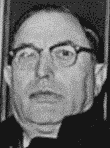
1925 – Giuseppe Profaci (Born Villabate, Sicily, Oct. 1, 1897. Died Bay Shore, NY, June 6, 1962). Profaci was descended from Mafia leaders in the Sicilian “Zubbio” organization of Villabate, Bagheria and nearby communities, and he was probably already highly regarded by relatives in the U.S. Mafia upon his 1921 immigration. Profaci initially settled in Chicago, where he managed a grocery. As the influence of Brooklyn-based Mafia boss of bosses Salvatore D’Aquila waned, Profaci began to travel again. He took a trip to Sicily in 1925 and then relocated from Chicago to Brooklyn by the middle of 1927. Salvatore DiBella gave way for Profaci to become a crime family boss. Profaci benefited from the demise of Brooklyn crime lord Frankie Yale in 1928, absorbing some of Yale’s rackets and followers. Profaci and brother-in-law Joe Magliocco were among the 21 suspicious persons arrested at a national Mafia convention at Cleveland’s Hotel Statler in December1928. Profaci maintained an outward neutrality during the Castellammarese War, though he was very close to Joseph Bonanno and secretly supported the Castellammarese effort against boss of bosses Joe Masseria.
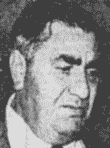
1958 – Joey Gallo and his brothers began to oppose boss Joe Profaci. The Gallo group splintered off from Profaci’s family over the boss’s abuses of power, and a civil war erupted in the organization. The Gallo grievance reportedly involved unjust Profaci disciplinary “hits,” regular fees Profaci assessed against made members of his crime family and Profaci’s failure to live up to promises he made to the Gallos. The Gallo revolt wins the quiet support of Anthony “Tony Bender” Strollo, leading figure in the Genovese Crime Family
1962 – Joseph Magliocco (Born Villabate, Sicily, c. 1897. Died Dec. 28, 1963). Joe Profaci died of cancer at Southside Hospital on Long Island, June 6, 1962. His brother-in-law Joe Magliocco succeeded him as boss of the family. The Gallo-Profaci War raged on.
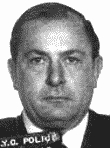
1963 – Joseph Colombo (Born June 16, 1923. Died May 22, 1978). Though Magliocco was Profaci’s chosen successor, a significant faction within the crime family was unhappy with the choice, and the Mafia Commission opposed it. When Magliocco was implicated in a Bonanno plot to assassinate two members of the commission – Carlo Gambino and Gaetano Lucchese – Magliocco was finally forced to resign. He died of natural causes near the end of 1963. “Sonny” Franzese looked to be next in line for the boss position, but, with the support of Carlo Gambino (who had been meddling in other family’s affairs), Joe Colombo was installed as family boss. Colombo is believed to have informed Gambino of the Bonanno-Magliocco plot against him. Colombo assigned aging Salvatore Mineo to be his underboss. Carmine Persico, formerly a member of the Gallo revolt, is elevated to capodecina.
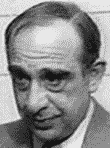
1971 – Carmine Persico (Born Aug. 8, 1933). A Joe Colombo courtship with the press apparently cost him Carlo Gambino’s support just before it cost him his life. Colombo was mortally wounded in 1971, as he prepared to open his well-publicized second annual Italian Unity Day in New York City. Colombo had been organizing an Italian-American Civil Rights League and picketing FBI offices to protest anti-Italian bias. As a result of the gunshot wound, he lapsed into a coma. He died years later, on May 22, 1978. Carmine “the Snake” Persico took over leadership of the family. On April 7, 1972, the Gallo revolt in the family was ended, as “Crazy Joe” Gallo was shot five times in Little Italy’s Umberto’s Clam House restaurant. Gallo died on the sidewalk outside the eatery on his 43rd birthday.

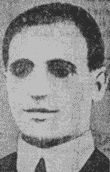
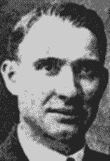
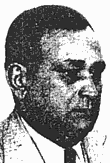
 Carey Estes Kefauver, born July 26, 1903, in Tennessee, was a graduate of the University of Tennessee at Knoxville and Yale University law department. Following the death of Congressman Sam Reynolds in 1939, Kefauver (a Democrat) was elected to complete Reynolds’ term. He was reelected four times. In 1948, he was elected to the Senate. Early in his first term, Kefauver drafted a resolution calling for a five-member special committee to investigate organized crime. The resolution succeeded in the spring of 1950 only due to the tie-breaking vote of Vice President Alben Barkley.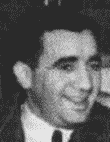
 Giuseppe Masseria of New York, the “boss of bosses” of his day, attempted to mediate the conflict between Aiello and Capone early in 1929 but only succeeded in offending Aiello (as well as his allies in Detroit, Buffalo and Brooklyn). During the early Castellammarese War, Aiello (a native of Bagheria, a wealthy suburb of Palermo) supported the forces of Salvatore Maranzano in New York against Masseria and Capone.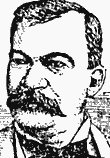

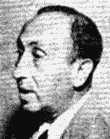
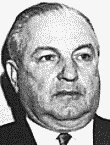
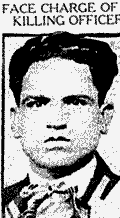
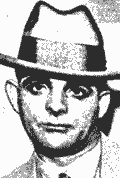
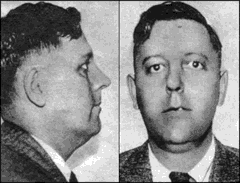
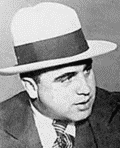
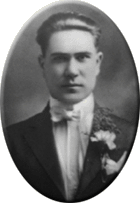
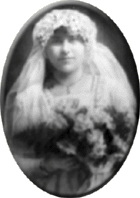
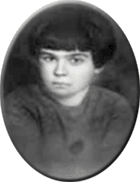

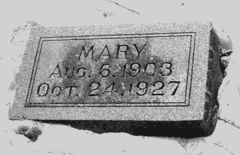 The News-Palladium declared that Tony’s “vow to avenge the dynamite death of his wife … must remain forever unfulfilled.”50 Although Tony’s murderers were never caught or prosecuted, Sebastiano purportedly believed that Capone was behind his death, furnishing a powerful reason for his eagerness to join in a Maranzano led war against the Capone-Masseria alliance.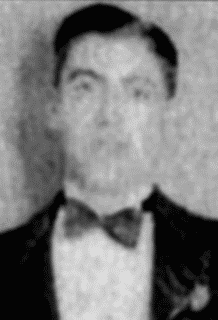
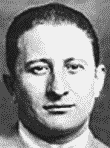
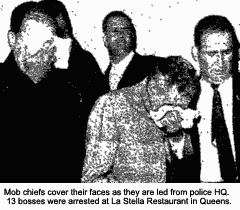 amily, as he was beginning a five-year federal sentence for perjury (another five-year sentence would be added on an additional perjury charge two years later). Antonio “Tony Ducks” Corallo’s election to the top post was delayed, as he was finishing up a prison term for bribing a city water commissioner. Racketeer Carmine Tramunti kept the seat warm as acting boss for Corallo for several years. Corallo, Lucchese’s formal successor, ran the Lucchese Crime Family empire for a decade and a half until the federal Commission trial in 1986. Corallo, already in his 70s, was sentenced to serve 100 years in prison. He died Aug. 23, 2000, at the age of 87.26