At a glance
- Date
- November 14, 1957
- Place
- Apalachin, New York
- Police account
- 62 guests detained for identification
- Legal result
- Later federal conspiracy convictions reversed
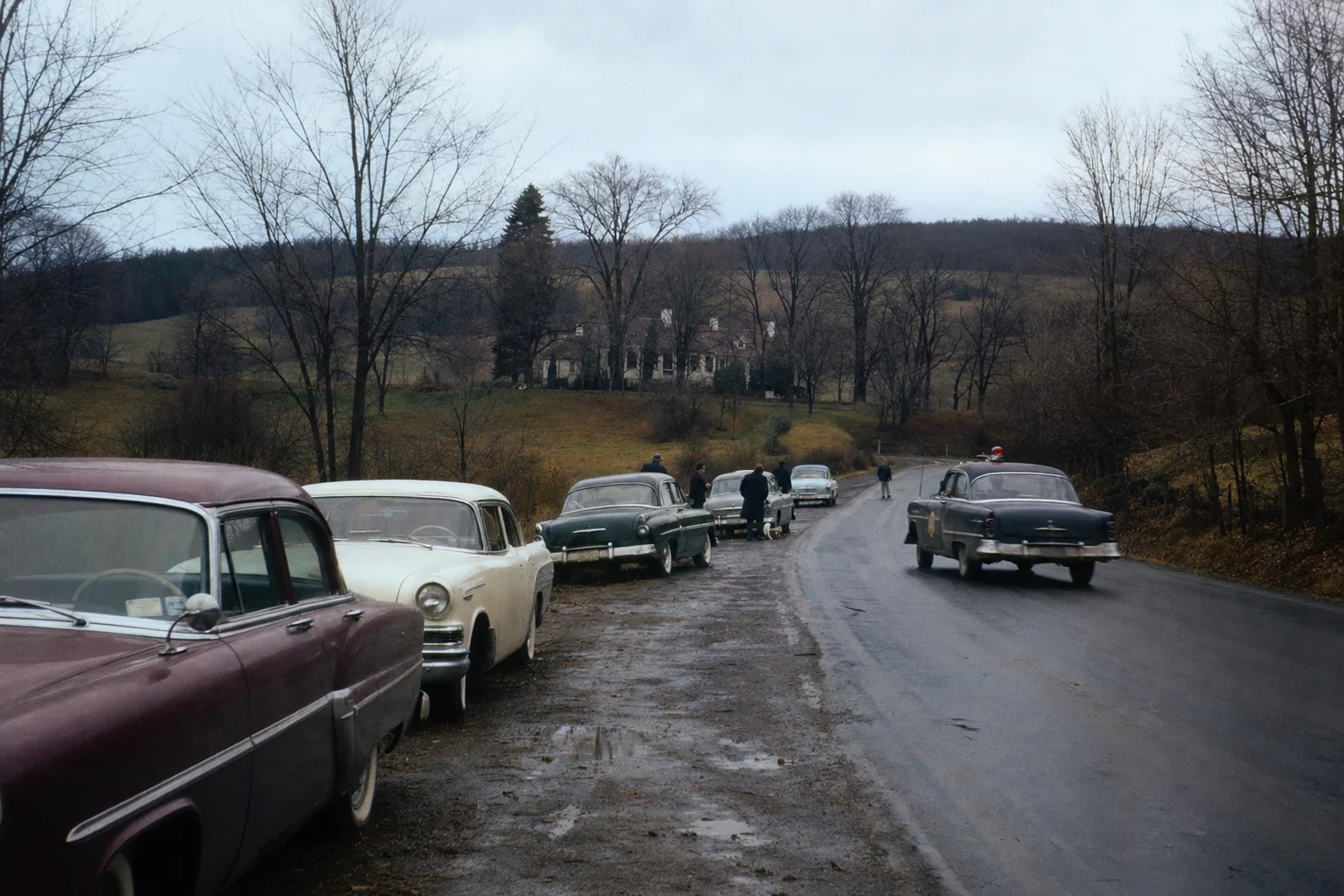
On November 14, 1957, New York State Police watched cars gather outside Joseph Barbara’s rural home in Apalachin, west of Binghamton. Officers wrote down license plates. Men at the property noticed them. Some drove away; others ran through the wet countryside.
The police stopped and identified dozens of people. The gathering became national news because many of those present were known or suspected organized-crime figures from several cities. Apalachin did not, by itself, prove what they planned to discuss. It did give law enforcement and the public a visible picture of a network that crossed local boundaries.
Attendance at a meeting is not proof of a crime. This account uses “identified,” “detained,” “alleged,” and “convicted” for different legal facts. It does not treat later reputation as proof of an uncharged purpose on November 14.
Organized crime in New York before Apalachin
American organized crime was already a subject of police work, journalism, and congressional inquiry. The Kefauver Committee had held televised hearings earlier in the decade. Local and federal files contained information about gambling, extortion, corruption, and links among crime figures.
What remained difficult was turning scattered knowledge into a public account of a national structure. Local cases could look local. Secretive organizations avoided minutes, public membership lists, and ordinary business records. Investigators often knew names without having courtroom-ready proof of how every group related to another.
Later stories assign a detailed agenda to the Apalachin meeting: leadership disputes, the killing of Albert Anastasia, narcotics, or recognition of Vito Genovese. Historians and participants have offered competing versions. The surviving record does not establish a complete agenda. A careful history can describe those interpretations only as interpretations.
Vito Genovese and the American Mafia power-play claim
Many accounts place Vito Genovese near the center of the meeting and describe him as seeking wider recognition after a struggle for power in New York. That explanation fits parts of the period, but it is not a proven meeting agenda. Later witnesses and writers did not all give the same version.
The safe claim is smaller. Genovese was among the major figures identified in official retellings of Apalachin. His place in New York crime history made his presence important. A claim about what he asked the group to approve needs a named source and a note about dispute.
Why were New York State Police watching Joseph Barbara’s home?
Joseph Barbara was a beverage distributor with a large property near Apalachin. New York State Police Sergeant Edgar D. Croswell had taken an interest in him and had seen suspicious visitors at the home before. On the day of the meeting, Croswell and Trooper Vincent Vasisko noticed the unusual traffic and began recording license plates.
The FBI’s later historical account says Barbara described the event as a soft-drink convention. That explanation did not settle the officers’ concern. Expensive cars with out-of-area plates were arriving at a private rural property. The officers did not begin with a large planned raid. Observation turned into a response as the gathering broke apart.
The distinction matters. Popular retellings often present a perfectly staged ambush. The better-supported picture is smaller: attentive state officers, known local context, license checks, flight, and an improvised roadblock.
Joseph Barbara, Tioga County, and the choice of place
Barbara’s home offered privacy, space, road access, and distance from a major city. Those traits help explain why the site worked for a large private gathering. They do not prove who chose it or why every guest came.
Barbara’s beverage business also gave him an ordinary reason to know people and to host visitors. Police interest came from the wider pattern they believed they saw, not from the fact that a bottler held a meal. A good case history keeps ordinary facts visible while testing the suspicious ones.
Tioga County mattered because the property was rural but connected by road to larger cities. That geography helps explain the police response and the difficulty of counting everyone who may have been present. It does not establish that Barbara selected the location for a proven criminal purpose.
What happened at the roadblock?
When people at the property saw police attention, many tried to leave. Some reached cars. Some went into nearby fields or woods. Police set up a roadblock and brought people in for identification and questioning.
The FBI’s history says officers detained 62 guests to check their identities. It names figures associated in law-enforcement records with several La Cosa Nostra families and regions. The Bureau later checked the names: its account says it already had information on 53 and that 40 had criminal records.
Those numbers describe what the FBI says its files contained, not a finding that every detained person committed a crime at the property. No illegal agenda was proven on the scene. Many people gave thin or implausible explanations for why they were in Apalachin, which fueled public suspicion and later legal action.
| Supported point | What it does not prove |
|---|---|
| A large interstate gathering occurred at Barbara’s home. | That every person shared one criminal purpose. |
| Many identified guests were known to law enforcement. | That a file entry was a conviction. |
| Guests fled after noticing police. | The exact reason each person fled. |
| The event drew national and federal attention. | That federal investigation began from nothing that day. |
The Apalachin meeting in a short timeline
- State and federal agencies investigate organized crime, while Senate hearings bring the subject to a national audience.
- Cars gather at Joseph Barbara’s Apalachin property. State police record plates and establish a roadblock as guests leave.
- Agencies compare identities, conduct interviews, and face public pressure to explain the gathering.
- Federal prosecutors obtain conspiracy convictions tied to allegedly false accounts of the meeting.
- The Second Circuit reverses the convictions and orders the conspiracy count dismissed for lack of adequate proof.
- Joseph Valachi’s Senate testimony gives the public a more detailed insider description of La Cosa Nostra.
- The federal RICO statute becomes one of the later tools used against criminal enterprises; it was not an immediate product of one meeting.
What happened in court?
Federal prosecutors later charged a group of attendees with conspiracy tied to their explanations of the gathering. Convictions followed in 1959. That result did not stand.
In United States v. Bufalino, the U.S. Court of Appeals for the Second Circuit reversed and directed dismissal of the conspiracy count. The court found the proof insufficient. Similar or evasive stories did not adequately prove the charged agreement, and the government could not show an unlawful purpose for the gathering itself.
The reproduced appellate opinion in United States v. Bufalino includes a blunt warning: the bad reputation of defendants cannot replace proof of the crime charged. That principle is more important than the meeting’s mythology.
The reversal does not mean the identified men had no organized-crime connections or no criminal records. It means those facts were not enough to sustain this conspiracy case. A factual history must hold both statements at once.
Did Apalachin force the FBI to admit Cosa Nostra existed?
The popular version says the FBI denied the Mafia until Apalachin, then suddenly changed course. The FBI’s own current history rejects that simple claim. It says the Bureau already held information on many guests and that the event intensified its interest rather than creating it from zero.
The Bureau’s national history of the period describes Croswell’s work, the 62 identifications, and the later file checks. Its Albany field-office history says the gathering brought national exposure to a network of criminal enterprises and led offices to gather more information.
These are institutional histories written by the FBI, so they also have a viewpoint. They are strong sources for what the Bureau says it knew and did. They should be read beside court opinions, state records, congressional material, and independent history.
What the Federal Bureau did—and did not—learn
The Federal Bureau of Investigation did not begin with an empty file cabinet. Federal agents and local authorities already tracked illegal gambling, protection money, violence, corruption, and suspected Mafia activity. Apalachin helped investigators compare those separate records across jurisdictions. It did not prove that every suspected racket—or later allegation about narcotics dealing—was discussed at the house.
The event also became part of a public argument about the Mafia’s existence. J. Edgar Hoover’s leadership and the Bureau’s earlier priorities remain subjects of historical debate. The careful conclusion is that the meeting increased pressure, visibility, and coordination. It is not that one roadblock instantly supplied the full structure of American organized crime.
Names in the history are not all names on an attendance list
Vito Genovese and Joseph Barbara are central to most accounts of the gathering. Other mob leaders—including Frank Costello and Joseph Bonanno of the Bonanno family—belong to the wider New York story but should not be inserted into a guest list without a reliable attendance source. The same rule applies to titles such as boss, acting boss, underboss, caporegime, or family soldier: a label in a later book is not self-proving evidence about November 14.
Newspapers, including The New York Times, helped turn the event into a national story. Later writers called it an “Apalachin summit” of organized crime leaders and linked it to internal power struggles. Those labels are interpretations. The Valachi Papers and later testimony changed public language again, but a later source cannot retroactively reveal the meeting’s complete agenda. Even the familiar “Edgar Hoover acknowledged the Mafia’s existence after the raid” line needs a dated source and careful wording.
Terms such as “indicted mafiosi,” “Mafia war,” “murder,” and “state prison” can compress different legal facts into a dramatic phrase. An indictment is not a conviction; a prison record does not prove why someone attended; and a history of crime in another part of the country is not evidence about this house. Justice depends on keeping those boundaries visible.
Why online attendee tables need a warning
The court opinion identifies the people below in the police or litigation record. The role labels are common descriptions in secondary attendance lists, not findings made by the appellate court. They should not be used to prove an agenda or criminal act.
| Court-record name | Secondary-list role label |
|---|---|
| John Ormento | Caporegime |
| Joseph “Joe Palisades” Rosato | Caporegime |
| Roy Carlisi | Caporegime |
| James LaDuca | Caporegime |
| Samuel Lagattuta | Caporegime |
| Anthony Guarnieri | Family soldier |
| James Osticco | Caporegime |
| Pasquale Turrigiano | Caporegime |
| Emanuel Zicari | Caporegime |
| Pasquale Monachino | Family soldier |
| Ignatius Cannone | Caporegime |
How law enforcement changed after the meeting
First, the image changed. A list of people from different regions, gathered in one rural place, was easier for the public to understand than a stack of separate local files. The meeting gave newspapers and officials a concrete national story.
Second, pressure increased. Agencies checked names, compared records, interviewed attendees, and answered questions about prior enforcement. The event did not create every later investigation, but it made fragmentation harder to defend.
Third, vocabulary and structure became public issues. Apalachin was followed by investigations and, in 1963, Valachi’s televised testimony. Over time, electronic surveillance, cooperating witnesses, enterprise prosecutions, and statutes including RICO altered the government’s capacity. Those changes unfolded across years. Crediting them all to one rainy afternoon turns history into a shortcut.
What changed in police work
The meeting showed the value of comparing local records. One plate, address, or name might mean little alone. A set of names from many states could show links worth lawful inquiry. That kind of work called for better sharing among state, local, and federal offices.
It also showed the limits of intelligence. Knowing that people met is not the same as proving why. Surveillance can form a lead. A criminal case still needs evidence tied to each legal element and each defendant.
Later federal cases used tools that were broader than a roadblock: wire evidence under legal orders, financial records, informants, undercover work, and enterprise laws. Apalachin became part of the case for coordination, but each later tool had its own legal path.
Apalachin mattered less because police discovered one secret agenda than because they made an interstate network visible.
Four myths worth correcting
Myth: Everyone at the house was arrested for being in the Mafia
Police detained and identified people. Attendance alone was not a crime. Later federal conspiracy convictions were reversed.
Myth: The full agenda is known
Writers have proposed subjects and motives, but the meeting’s full purpose was not proven in court. Specific agenda claims need attribution.
Myth: Police planned a massive federal raid
The event grew from state police observation and license checks. The response expanded as guests fled.
Myth: Apalachin immediately produced RICO
RICO became law in 1970 after a much longer policy history. Apalachin belongs in that history, but it was not a direct one-step cause.
Apalachin in popular culture
Films, television, podcasts, and books often use Apalachin as a reveal: a secret national organization exposed by one curious officer. That shape works well on screen because it has place, weather, cars, flight, and surprise.
The real record is more useful. It includes good local police work, prior files, uncertain purpose, public shock, failed prosecutions, and a long enforcement response. The court reversal is not a footnote to remove from the drama. It shows why suspicion and proof are different public duties.
How to research the meeting without repeating lore
Start with the date, place, officers, and identified guests in government histories. Use the appellate opinion for the legal result. Then compare later books and press accounts. When two authors repeat the same old witness, count that as one source line, not two.
Keep a claim ledger. Mark each item as observed, reported at the time, testified later, alleged by investigators, found by a court, reversed on appeal, or inferred by a historian. The labels make disagreement easier to see.
Maps and weather can help explain the flight and roadblock. They cannot reveal the agenda. Photographs can show who was present only when identity and date are secure. A dramatic caption is not an archive.
Questions about the Apalachin meeting
When was the Apalachin meeting?
It took place on November 14, 1957, at Joseph Barbara’s property near Apalachin, New York.
Who found the meeting?
New York State Police Sergeant Edgar D. Croswell and Trooper Vincent Vasisko observed the gathering and recorded license plates. Police established a roadblock as guests left.
How many people were detained?
The FBI’s current historical account says 62 guests were detained for identification checks. Other retellings use different attendance estimates because some people escaped and total attendance was uncertain.
Were the Apalachin convictions upheld?
No. The Second Circuit reversed the federal conspiracy convictions in 1960 and directed dismissal of the conspiracy count.
Why is the meeting important?
It made interstate organized-crime links visible to a national audience and increased pressure for coordinated investigation. Its significance does not depend on proving a single secret agenda.
The record is stronger than the legend
Apalachin became a turning point because ordinary police observation exposed an extraordinary gathering. Its legacy also includes a legal limit: public certainty about who the men were could not substitute for proof of the conspiracy charged.
That combination—discovery and restraint—is the durable lesson. Follow the cars. Check the names. Read the court’s reversal. Keep what is known separate from what later storytellers supplied.