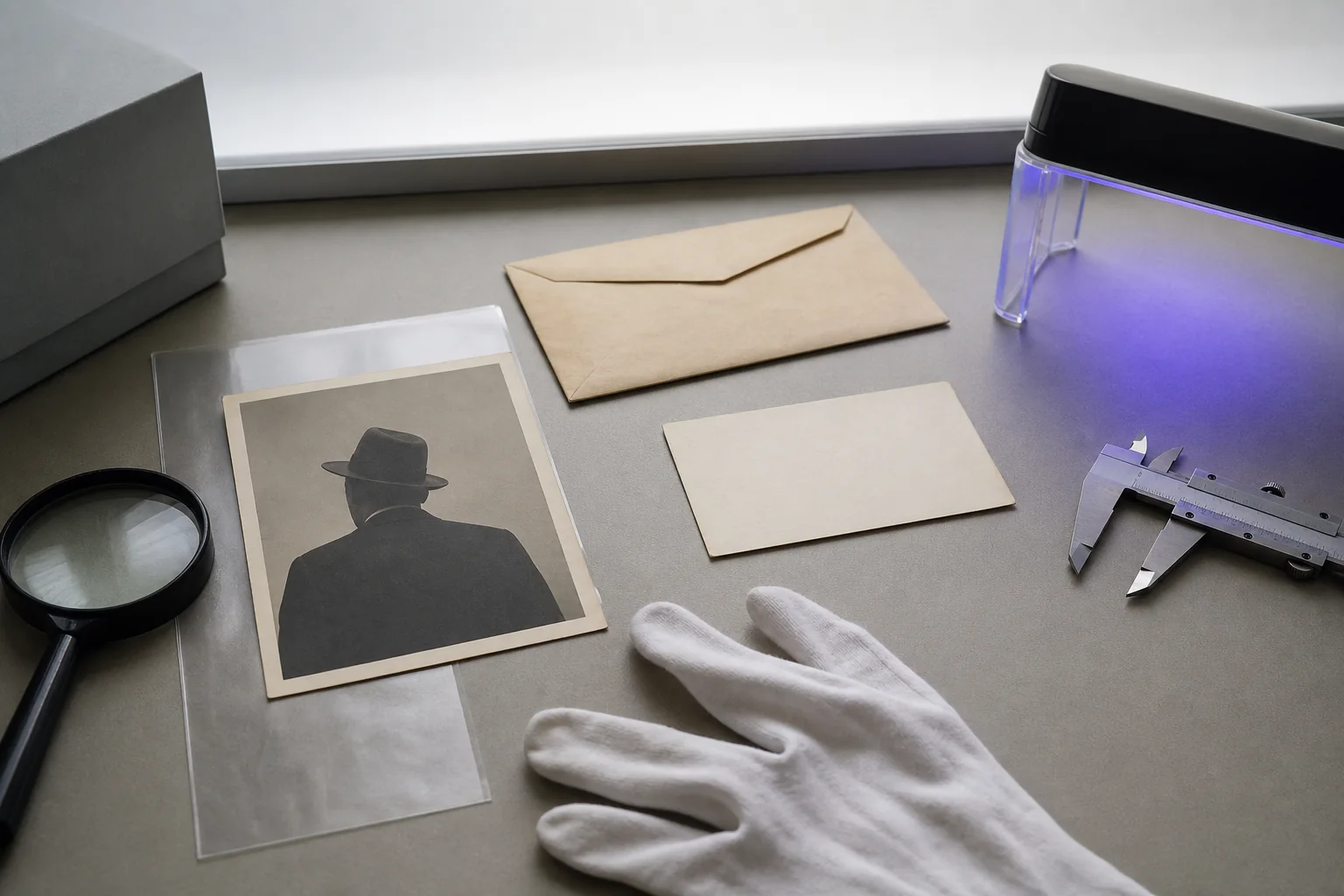
At a glance
- Subject
- Al Capone, 1899–1947
- Main risk
- Famous-name misattribution
- Best support
- Contemporaneous custody records
- Affiliate status
- No auction commissions
Why Capone’s name creates unusual risk
Al Capone is one of the few organized-crime figures whose name functions as a general symbol of an era. That fame expands the market for signed paper, photographs, prison material, weapons, household objects, hotel items, and anything said to come from a Chicago address.
It also creates a strong incentive to upgrade “period object” into “Capone object.” A 1920s glass from Chicago may be authentic to the era and still have no connection to Capone. Attribution is the value-bearing claim, so attribution needs the strongest file.
Common item types and the question each raises
| Item | Main question | Useful support |
|---|---|---|
| Signature or letter | Was it written by Capone? | Custody, paper and ink, dated comparisons |
| Photograph | What is the print, not only the image? | Photographer stamp, publication history, negative |
| Personal object | How did it leave the household? | Estate inventory, family record, continuous bills of sale |
| Prison or government paper | Can it be privately owned? | Deaccession or lawful transfer documentation |
Signatures and photographs
Do not authenticate a signature from one online image. Resolution, lighting, and compression hide ink flow and paper. A specialist should compare dated examples, inspect materials, consider whether an assistant could have signed, and explain the limits of the conclusion.
A photograph has several dates: when the scene occurred, when a negative was made, when this print was produced, and when any caption was added. A later press print can depict Capone without being an object he owned or handled.
The FBI’s Capone case history is useful for a basic chronology. It can help test whether an inscription or claimed location fits, but it cannot establish the custody of a private object.
Government records and copied files
The FBI makes released Capone files available through the FBI Vault. A downloaded or printed page is a reproduction, even if the underlying scan depicts a real government record. Sellers should identify reproductions plainly.
An original government document requires a title check. Marks, file holes, stamps, and aging can suggest institutional use but do not prove lawful removal. The National Archives’ recovery program provides a path for reporting material suspected of being stolen from federal custody.
A pre-purchase checklist
- Write the seller’s exact attribution in one sentence.
- Request the custody chain and every supporting document.
- Separate object age from famous-person ownership.
- Check dates against an independent chronology.
- Use a specialist who is independent of the sale.
- Confirm lawful title and return terms in writing.
- Budget for conservation and insurance, not only the hammer price.
One Wal does not estimate value. Prices move with condition, documentation, market fashion, and bidder confidence. A lower-priced object with a clean chain may be historically stronger than a spectacular object supported by only a story.
Al Capone as a Prohibition-era crime boss
Capone rose to national notoriety in Chicago during Prohibition, when illegal alcohol, gambling, vice, political corruption, and violence created a large public story. His fame was amplified by newspapers and photographs. The memorabilia market inherits both the historical record and that media construction.
Dates provide the first authenticity screen. Capone was born in 1899, became a major Chicago figure in the 1920s, was convicted of federal tax offenses in 1931, served time in federal prisons including Alcatraz, and died in 1947. An item’s maker, address, paper, photograph process, or inscription must fit the claimed point in that chronology.
Tax-evasion evidence and legal documents
Tax documents have special appeal because the conviction became the most famous legal outcome of Capone’s career. Distinguish an original court filing, certified copy, contemporary press copy, later archive reproduction, and modern printout. They may display the same text while having very different status and value.
A document mentioning Capone is not necessarily his personal item. Court and agency papers were created by institutions, often in multiple copies. File stamps, docket information, custody, and deaccession history matter more than a dramatic sentence.
The Lexington Hotel and site-related memorabilia
The Lexington Hotel became closely associated with Capone’s Chicago image and later with televised searches for a supposed vault. Keys, dishes, bricks, signs, stationery, and furniture may be marketed through that association. Ask whether the item can be traced to the hotel, when it was removed, and whether it can be tied to Capone rather than only to the building.
Site provenance has levels. “From a Chicago hotel of the period,” “from the Lexington Hotel,” “from a room associated with Capone,” and “owned by Capone” are four different claims.
Ralph Capone, Mae Capone, and family custody
Family provenance can be powerful when supported by estate records, photographs, correspondence, or a continuous sale history. Mae Capone, Ralph Capone, descendants, and other relatives had their own lives and property. An item from a relative’s estate is not automatically an item Al Capone used.
Request the exact relationship, estate date, inventory reference, and path to the current seller. “From the Capone family” is too broad to carry a large premium without those details.
Auctioning and pricing Al Capone memorabilia
Auction catalogs should identify provenance, condition, dimensions, materials, inscriptions, and the basis of attribution. Read whether language says “by,” “owned by,” “attributed to,” “associated with,” or “in the style of.” The qualifiers are part of the lot description.
Comparable sales work only when the objects are genuinely comparable. Two signatures can differ by document type, date, condition, inscription, custody, and specialist opinion. Do not use one spectacular auction result as a price guide for every signed scrap.
Conservation and responsible display
Store paper and photographs in archival materials away from direct light. Avoid pressure-sensitive tape, lamination, and irreversible framing. Do not polish metal or clean fabric until a conservator has evaluated whether residues, markings, or wear carry evidence.
A display should explain why Capone became famous, the tax conviction, the criminal harm surrounding the era, and what is actually known about the object. A responsible label can say “attributed to Al Capone; chain begins with a 1985 auction” when that is the truth.
Fraud indicators specific to Capone material
- A seller claims the object came from Capone’s vault but supplies no inventory.
- A signature style is compared only with other items sold by the same dealer.
- A prison item lacks an inmate number, institutional mark, or lawful custody path.
- A Lexington Hotel object has no demolition, salvage, or ownership documentation.
- A family story begins decades after Capone’s death with no intervening records.
- The certificate repeats the seller’s wording without independent analysis.
Due diligence before purchase
Build a one-page evidence file. Put the claimed object description at the top. Add a chronology, provenance chain, material findings, comparison examples, title statement, expert disclosures, and unresolved gaps. Decide what the object is worth if the Capone attribution fails.
The strongest purchase is not the one with the most theatrical story. It is the one whose description remains accurate after every qualifier is made visible.
Al Capone signatures: comparison is not enough
A signature review should consider known dates, writing instrument, paper, document purpose, inscription, and custody. Capone’s health and circumstances changed over time, so one “textbook” example cannot represent every genuine signature. Secretarial or copied signatures add further risk.
Request the authenticator’s comparison set and reasoning. A sticker or database number without a written conclusion leaves the buyer unable to evaluate the method.
Prison memorabilia
Items attributed to Atlanta federal prison, Alcatraz, or other custody can include correspondence, forms, crafts, identification material, and objects said to come from a cell. Confirm that the object type was available in the institution and that private ownership is lawful.
A letter mailed from prison can have an envelope, censor mark, return address, date, and recipient history. Those independent features can form a stronger chain than a loose object with a prison story.
Weapons and the problem of dramatic attribution
Weapons marketed as Capone-owned or tied to a famous crime need exceptional evidence. Serial-number history, registration where applicable, photographs, bills of sale, police custody, and estate records may help. Period, caliber, or Chicago origin alone cannot connect a weapon to Capone.
Photographs, newspapers, and popular culture
An original press photograph may have strong historical value through agency stamps, caption sheets, and publication history even if Capone never owned it. A newspaper is usually mass-produced. Its value depends on edition, condition, headline, completeness, and provenance rather than celebrity ownership.
Later films, television programs, posters, and souvenirs are Capone popular culture, not lifetime memorabilia. Labeling the category accurately protects both buyers and history.
Why the Al Capone name requires stronger evidence
Capone’s fame creates a large premium between an ordinary Prohibition-era object and one he demonstrably owned, signed, received, used, or encountered. That premium creates an equally strong incentive to add a story to an otherwise authentic item. The correct standard rises with the claim: the more valuable and dramatic the attribution, the more independent links the provenance should contain.
Separate five propositions. The object may be old. It may come from Chicago. It may be the type Capone could have used. It may have passed through a person connected to him. It may have belonged to Capone. Each step requires new evidence; the first four do not automatically prove the fifth.
Letters, envelopes, checks, and business records
A signed document should make sense as a whole. Check the letterhead, form, account, payee, date, address, postal marks, recipient, subject, and custody history before focusing on handwriting. A genuine blank form or period check can receive a false signature decades later. Conversely, a routine document with strong context may be more defensible than a spectacular loose autograph.
Envelopes are evidence when they remain linked to their contents. A postmark, prison censor mark, return address, routing notation, and recipient archive can support date and custody. Do not separate them for display. Keep scans of front, back, interior, and any enclosure together.
Photographs of Capone: four dates to record
Record the event date, negative or capture date, print date, and publication or acquisition date. They may be different. A press photograph printed years after the event can still be historically useful, but it should not be sold as a first-generation print without evidence. Agency stamps, caption sheets, paper, process, crop marks, and newsroom annotations help identify the print’s history.
A photograph showing Capone proves that he was depicted at the captured moment. It does not prove he owned the print, signed it, knew every person shown, or visited the seller’s claimed location on another date. Read the image, caption, and ownership chain as separate sources.
Family provenance and estate documentation
Material attributed to Mae Capone, Ralph Capone, descendants, employees, lawyers, or associates can have a plausible route into private hands. The relationship alone is not the chain. Ask which family member possessed the item, when it transferred, whether an inventory or correspondence mentions it, and how it reached the present consignor.
Privacy and incomplete estate practices can leave gaps, especially for ordinary personal effects. Describe those gaps openly. A signed affidavit created at the time of sale is weaker than dated family photographs, letters, insurance schedules, or earlier inventories, but it can preserve the consignor’s claim for future research.
Prison records and objects attributed to Alcatraz
Capone’s incarceration makes Alcatraz and federal-prison material especially marketable. First identify whether the item type was issued, permitted, or produced at the relevant institution during the claimed period. Compare institutional numbers, stamps, forms, mail rules, and materials with archive or museum examples.
Then establish lawful release. A government form found in private hands may be a legal copy, a discarded duplicate, or property that should not have left custody. An object said to come from a cell needs more than a former employee’s general access to the prison. Ask for an item-specific transfer.
Firearms, vehicles, furniture, and other high-value objects
Large objects produce dramatic catalogs and complicated chains. Serial numbers, registrations, bills of sale, repair records, photographs, insurance schedules, estate inventories, and shipping documents may connect an item through time. Model year and Chicago location only establish possibility.
Firearms also require current legal review for transfer, transport, and possession. A claim that a weapon was used in a crime needs a traceable law-enforcement, ballistic, or court-exhibit record. Never infer use from caliber, period, or ownership alone.
Tax-evasion case material and reproductions
Capone’s federal tax prosecution generated documents whose legal significance can be checked through court and archival records. Original court property, certified copies, contemporary press material, later facsimiles, and decorative reproductions are different categories. A document reproducing genuine text is not necessarily an original filing.
Identify the court, case, document type, filing date, page sequence, stamps, and source of the copy. The historical importance comes from the case and the record; private ownership by Capone is not required. This distinction lets collectors value evidence without inventing personal provenance.
An authentication file for Al Capone memorabilia
- Write the exact attribution in one testable sentence.
- Photograph every side, mark, label, repair, enclosure, and container.
- Identify the object’s materials, manufacturer, and earliest possible date.
- Build a dated ownership chain and flag every unsupported interval.
- Compare signatures or institutional features with reliable, relevant examples.
- Check title, transfer law, stolen-property databases, and archive concerns.
- Seek an independent specialist whose method and conflicts are disclosed.
- Keep the invoice, guarantee, return terms, expert report, and research together.
A strong file may not produce absolute certainty. It should make the remaining uncertainty visible enough for a buyer, curator, insurer, or future researcher to reach an informed conclusion.
Pricing without paying for an unsupported story
Start with the object’s value if the Capone attribution fails. Then consider the strength of the chain, rarity, condition, historical importance, exhibition history, and comparable sales. This two-level approach prevents a buyer from paying a celebrity premium for an item that remains valuable only as generic period material.
Use realized prices for closely comparable objects and include buyer’s premium and sale date. Treat estimates and asking prices as signals, not results. If the attribution depends entirely on one revocable opinion or an unnamed family source, price the uncertainty rather than the headline.
Scientific testing: useful, limited, and sometimes destructive
Paper fiber, ink, pigment, metal, wood, textile, photographic process, and tool-mark analysis can help determine whether an object is consistent with a claimed period. Testing usually establishes possibility or detects anachronism; it rarely proves that Capone owned the object. A period-correct result narrows the question but leaves provenance to solve.
Ask whether sampling is destructive, how large the sample must be, which laboratory will work, and what comparison data supports the conclusion. Document the tested location and preserve the full report. Do not allow an owner or seller to summarize a technical result more confidently than the analyst did.
Chicago locations and site-related souvenirs
Items associated with the Lexington Hotel, Cicero, restaurants, residences, court buildings, and other Capone-linked locations need an item-specific chain. A brick, key, menu, matchbook, or piece of furniture can be authentic to a business or demolition without ever having been handled by Capone. Site provenance and personal provenance are separate premiums.
Confirm addresses and dates because buildings are remodeled, renumbered, rebuilt, or replaced. A later business may market the history of its site while using objects created long after Capone’s lifetime. Label architectural salvage, commercial ephemera, and tourist souvenirs accurately.
Newspapers and the difference between history and rarity
A newspaper reporting Capone’s arrest, trial, conviction, imprisonment, illness, or death can be a valuable contemporary source. Most issues were mass-produced. Edition, city, completeness, headline placement, photographs, condition, and survival determine collectibility. The fact that the paper reports Capone does not create personal ownership.
Preserve the full issue when possible. Removing a front page or article destroys context and can reduce research value. Record the publication title, date, edition, volume, issue, and page so the report can be located in another archive.
Red flags in an Al Capone auction description
- “Museum quality” without naming a museum, exhibition, or standard.
- “From a close associate” without an identified custody chain.
- A certificate that repeats the seller’s story but adds no method.
- A signature opinion based on one online image or one exemplar.
- Period-correct materials presented as proof of personal ownership.
- A famous-crime attribution without police, ballistic, or court records.
- An original government document with no explanation of lawful release.
- A guarantee that disappears from the invoice or excludes attribution.
Responsible interpretation after authentication
An authenticated Capone object still needs interpretation. A tax document may illuminate federal prosecution. A hotel photograph may show urban change. A prison letter may reveal censorship, family relationships, or incarceration. A newspaper can show how public celebrity was made. The object’s most useful story may be institutional rather than glamorous.
Describe victims and consequences where relevant, avoid treating coercion as luxury branding, and distinguish Capone’s documented actions from the mythology that grew around them. Provenance protects the object; responsible context protects the history.
Al Capone memorabilia questions
How can Al Capone memorabilia be authenticated?
Start with provenance, contemporaneous records, materials, comparison examples, and an independent specialist with a disclosed method.
Does a photograph with Capone prove he owned it?
No. The image’s subject, print date, photographer, publication history, and ownership are separate questions.
Are FBI files proof that an object belonged to Capone?
No. Files can provide comparison context, but an item still needs its own documented chain.