At a glance
- Typical length
- About 90 minutes to two hours
- Common format
- Bus or minibus with guided stops
- Booking rule
- Verify pickup and accessibility directly
- Affiliate status
- No tour commissions
What to compare before choosing a Chicago gangster tour
Start with the route, not the fedora. Chicago’s organized-crime history crosses the Near North Side, Lincoln Park, Cicero, old vice districts, courts, hotels, churches, and addresses that no longer look as they did. A tour that promises every famous location in a short loop may be substituting a name check for context.
Ask five practical questions: Is the tour on foot or by vehicle? Where exactly is pickup? How long is the route in ordinary traffic? Can the operator accommodate a wheelchair or a traveler who cannot climb bus steps? Which stops are seen from the street rather than entered? The answers determine whether the tour fits your day before its history is considered.
| Feature | Why it matters | What to verify |
|---|---|---|
| Vehicle tour | Covers scattered sites | Bus access, restroom breaks, traffic changes |
| Walking tour | More neighborhood detail | Distance, pace, surfaces, weather policy |
| Costumed guide | Can make chronology memorable | Whether performance is separated from evidence |
| Historic media | Lets the record travel with the story | Dates, captions, and source labels |
Routes and formats
Untouchable Tours currently describes a themed bus tour departing from 600 North Clark Street. Its published route includes sites associated with the St. Valentine’s Day Massacre, the Biograph Theater, and Holy Name Cathedral. The operator lists a running time of roughly 90 minutes to two hours, with advance reservations encouraged.
Chicago Crime Tours also describes vehicle-based tours of crime and mob sites, with a typical length of 90 minutes to two hours. Its format mixes stops, city history, and a small collection of crime-related material. These descriptions establish format and logistics; they do not independently verify every story told on board.
Routes change. Construction, street closures, private events, and traffic can remove a stop without notice. Treat a list of locations as an intended itinerary, not a contractual sequence.
How to check the claims you hear
A responsible claim has four parts: a person or event, a date, a place, and a source type. “Capone came here” is atmosphere. “A dated newspaper report placed Capone here during this event” is a claim a reader can test. Court opinions, city records, contemporaneous newspapers, building records, and archival photographs carry different kinds of weight.
Watch for compressed language. An arrest is not a conviction. An indictment is an accusation. A building may stand on the site of an earlier structure without being the same room. A later owner’s story may be worth preserving as folklore but should not be relabeled as established fact.
Practical planning
Arrive early enough to find the exact pickup point. For a bus tour, ask whether seating is assigned and whether the vehicle has an accessible lift. For a walking tour, check the total distance, stair use, restroom access, and the rain or extreme-heat policy. Evening departures need an extra look at lighting and the return point.
Do not assume the ticket includes entrance to a museum, restaurant, bar, or private building. Many famous locations are ordinary businesses, residences, vacant sites, or reconstructed streetscapes. Photograph from public space and respect the people using the neighborhood now.
What a responsible tour should do
The history is not only a roster of bosses. Chicago’s record includes victims, journalists, prosecutors, police corruption, labor racketeering, political protection, neighborhood change, and the uneven consequences of Prohibition. A route becomes more useful when it explains systems and harm alongside personalities.
Performance is not automatically a problem. A lively guide can help a visitor follow dates and locations. The line is crossed when a joke erases a victim, an ethnic stereotype stands in for evidence, or a disputed tale is sold as a secret that “history books will not tell you.”
Chicago history, Untouchable Tours, and the route question
A Chicago gangster tour usually competes on personality, route coverage, and convenience. Untouchable Tours is the long-running actor-guide option most visitors encounter, while other Chicago crime tours combine mob history with cases from different periods. Neither format is automatically more accurate. The useful comparison is whether the guide can connect Chicago history to a dated source and make clear when a story is only local folklore.
Prohibition is an essential frame, but a Chicago gangster tour should not imply that organized crime began or ended with Al Capone. The tour route may mention the Chicago Outfit, the St. Valentine’s Day Massacre, North Side rivals, political protection, illegal alcohol, and later crime. These subjects span different organizations and legal records. A good guide explains the shift instead of placing every event inside one Capone story.
Booking, arrival, and the way the tour runs
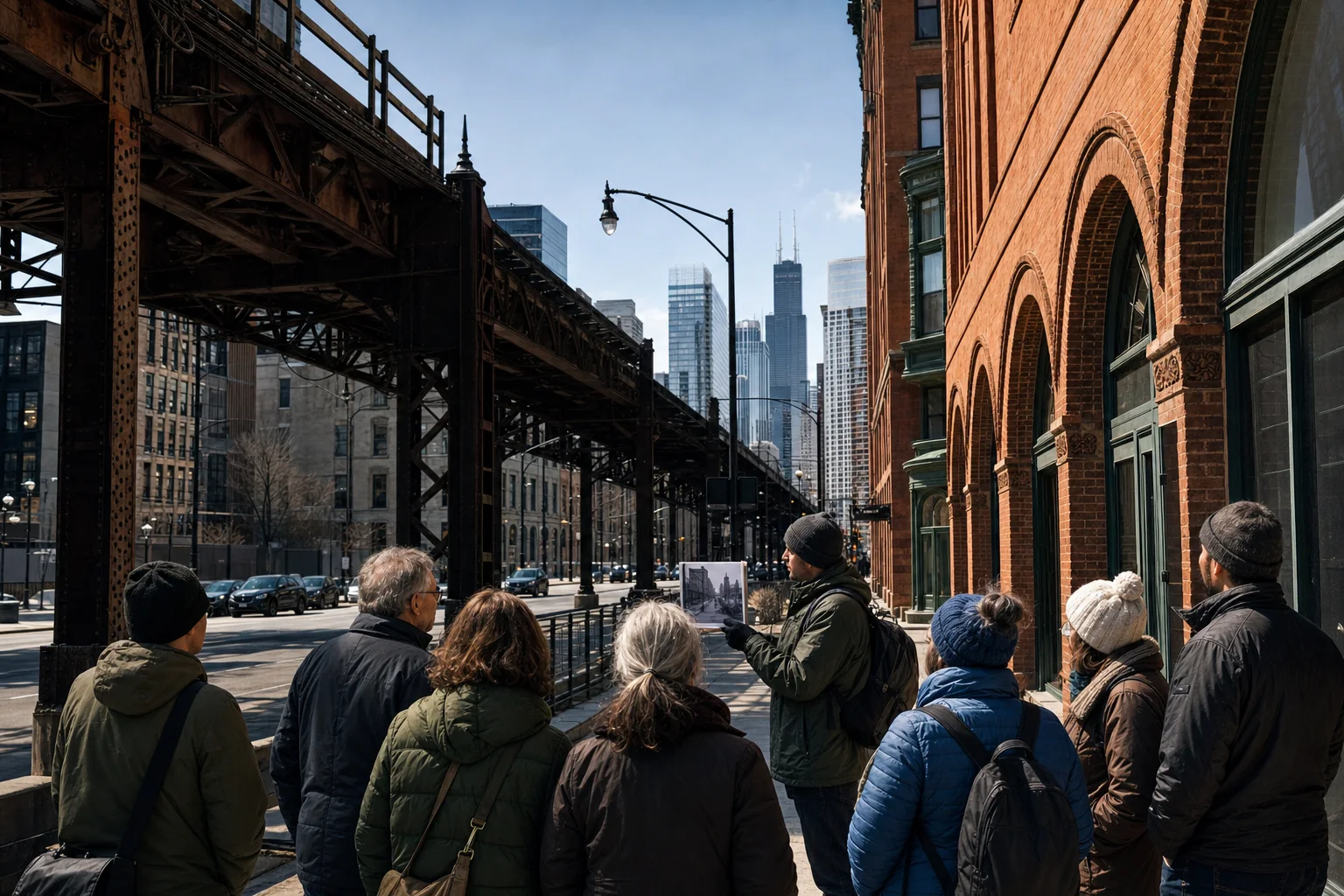
Read the booking confirmation for the exact meeting point, arrival time, cancellation terms, and contact number. A bus tour can cover more Chicago history than a walking tour, but the view of each site may be brief. Walking tours offer more street-level context and less geographic range. Private tours may allow questions and a custom pace, although a higher price is not proof of better research.
After the tour, save the operator’s source list if one is offered. Search the named event rather than the dramatic nickname alone. That small step turns a Chicago gangster experience into the beginning of historical research rather than the end of it.
Chicago gangster tour: a quick comparison
For the broadest geographic coverage, choose a Chicago gangster bus tour and confirm how many sites are actual stops rather than drive-by views. For slower neighborhood context, choose a walking tour and check distance, weather, and accessibility first. Untouchable Tours emphasizes costumed performance and Prohibition-era locations; Chicago Crime Tours combines mob history with other crimes and city cases. Both are commercial experiences, so compare their current routes, ticket terms, and source practices directly.
The best Chicago crime tour for a history-minded visitor is the one that clearly separates Al Capone folklore from documented Chicago Outfit history. Look for dates, captions, court or archival references, and an explanation of what survives at each address. No route can cover every crime family, speakeasy, political relationship, and Prohibition conflict in two hours. A focused, accurately sourced tour is more useful than a long list of famous names.
Chicago gangster tour questions
How long are Chicago gangster tours?
Major operators currently describe tours lasting roughly 90 minutes to two hours.
Do tours enter every historic site?
No. Most locations are viewed from a vehicle or public street, and routes can change with traffic or access.
Does One Wal sell tour tickets?
No. This guide has no affiliate links or ticket commissions.